Get 20% off orders over £50 with discount code REWIND
 01423 319041

What do you want to convert?
Back to Blogs
What is Digitisation?
Sean Parle • 26 August 2026
What is Digitisation?
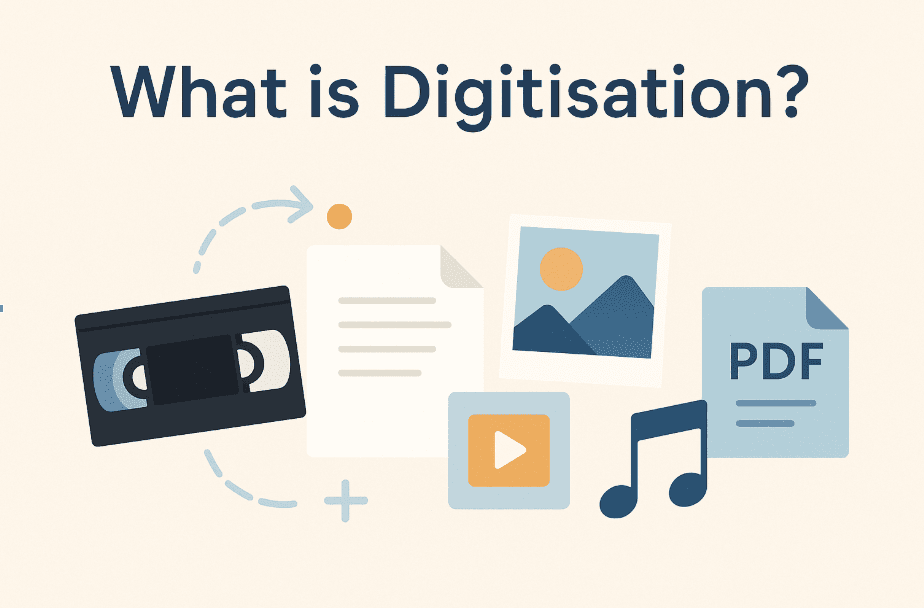
Digitisation. At its heart, it’s a simple idea: converting physical or analogue material into a digital format. Whether you’re scanning a birth certificate, transferring old VHS tapes to digital formats, or preserving centuries-old manuscripts, you’re taking something rooted in the physical world and turning it into a series of zeros and ones.
Yet behind that simplicity sits a vast history, a powerful cultural impact, and a practical toolkit that touches almost every aspect of daily life.
The Core Definition
Digitisation means conversion. It is the process of taking analogue material - paper, film, audio tape, photographs, vinyl records - and translating it into a format that computers can store, read, and reproduce.
What’s The Difference Between Digitising and Digitalisation?
Digitisation is different from digitalisation, which refers to using digital technologies to change how a business or institution operates. For example, a hospital scanning X-rays is digitisation; setting up an online patient portal to share those scans is digitalisation. The terms overlap, but they describe distinct steps.
A digital file might be a JPEG image, a PDF document, an MP4 video, or a WAV audio track. Each one compresses or represents information differently, but all are built on the same principle: turning analogue signals into digital data.
A VHS tape converted to MP4 illustrates the point perfectly. The tape stores magnetic signals; a professional converter reads them, translates them into digital code, and produces a file that can play on a smartphone, laptop, or smart TV.
A Brief History of Digitisation
Although digitisation sounds like a modern obsession, the roots stretch back further than many realise.
Punch cards (1800s): Early census bureaus and textile looms used punched cards to store data in coded form. Not digital by today’s standards, but a clear step towards encoding the physical into machine-readable form.
Microfilm (20th century): Governments and libraries began shrinking newspapers and documents onto reels of film to save space and protect originals. A precursor to digital storage, but still analogue.
Magnetic tape and vinyl: The music and film industries lived on these for decades. Durable at first, but prone to degradation.
The CD revolution (1980s): Compact discs brought the public into digital life. For the first time, millions of households had data encoded as zeros and ones spinning on a plastic disc.
The consumer boom (1990s–2000s): As scanners, CD burners, and later broadband spread, families began scanning photos, ripping CDs, and burning DVDs. Suddenly digitisation wasn’t just an institutional affair - it was personal.
By the 2010s, smartphones placed digitisation in everyone’s hands. A simple camera app meant instant copies of receipts, contracts, and photographs. At the same time, large institutions accelerated major digitisation projects - Google Books scanned millions of titles, while national archives across Europe raced to secure fragile materials.
Why Digitisation Matters
Preservation
Simply put, analogue formats decay. VHS tapes don’t last forever - tapes shed magnetic coating after just a few decades. Paper yellows, ink fades, film becomes brittle. Without digitisation, archives and personal collections risk being lost forever. A British Library study in 2019 warned that millions of magnetic tapes would become unplayable by 2025 due to equipment scarcity and tape degradation.
Digitisation acts as a safety net. Even when an original is destroyed, a digital version can live on. In museums, high-resolution scans of fragile manuscripts are now often the only way scholars can examine them closely without risking damage.
Accessibility
A diary entry from 1910 locked in a physical archive is accessible to a handful of researchers. Once digitised, it can be read worldwide at the click of a button. Families who once had a single copy of a wedding video can now share it instantly with relatives overseas.
Accessibility also means compatibility. A tape may require a rare VHS player, but an MP4 file will open on nearly any device. For many families, this is the difference between losing treasured footage and being able to watch it at Christmas with grandchildren.
Efficiency
Physical storage takes space. Filing cabinets, reels, tapes - all demand rooms and climate control. Digital files shrink whole libraries into a hard drive or cloud server. This has transformed business compliance, university archives, and even personal storage.
Efficiency also means searchability. A digital archive can be indexed, tagged, and keyword searched in seconds. A warehouse of paper takes days to comb through.
Security
Fires, floods, theft: all can wipe out physical archives in seconds. Digital files can be backed up, duplicated, and stored across continents. One loss no longer means permanent erasure.
Security isn’t just about disaster recovery, it also means controlled access. Sensitive documents can be password protected, encrypted, and shared selectively - a far cry from unlocked filing cabinets.
Common Examples of Digitisation
The term can sound abstract, but examples are everywhere:
Media formats: VHS, Betamax, Video8, MiniDV, cine reels, and audio cassettes all being transferred to digital.
Documents: Contracts, medical records, deeds, and invoices. Governments have pushed hard for paperless systems.
Photographs: Prints, negatives, and slides scanned into JPEG or TIFF files and stored on a USB stick.
Industrial and scientific records: Blueprints, lab notebooks, X-rays, seismic recordings.
Cultural heritage: Paintings scanned in ultra-high resolution, ancient manuscripts photographed page by page.
In each case, the same principle applies: the analogue is captured, stored, and reproduced as data.
How the Process Works in Practice
Digitisation might sound straightforward - just point a scanner or hit record - but real projects require careful handling.
1. Preparation
Inspect condition. A mouldy VHS tape needs cleaning before playback, or it risks destroying the machine.
Repair where possible. Spliced film, broken cassette shells, torn documents - all need stabilising first.
2. Conversion
Use specialist equipment: broadcast-grade VCRs, high-resolution scanners, calibrated capture devices.
Capture settings matter. Bitrate, resolution, and colour depth determine future usability.
3. Output
Choose the right format. MP4 for general video use, WAV for archival audio, TIFF for images where compression loss is unacceptable.
Store in multiple places: local hard drives, network servers, cloud systems.
4. Quality control
Files are checked against the original to spot errors.
Where problems appear - tracking issues on tapes, flicker in cine reels - adjustments or repeat transfers are made.
Done well - by experts such as ourselves, Digital Converters - digitisation balances technical expertise with preservation care.
The Benefits and the Limits
Advantages
The benefits are far-reaching:
Longevity: Digital files, if properly backed up and migrated, can last indefinitely.
Perfect copies: Unlike analogue duplication, which introduces noise and distortion, digital copying produces identical results.
Wider reach: Families, researchers, or businesses can distribute files across the world instantly.
Compatibility: A digital photograph can be printed, emailed, or embedded in a website - all from the same master file.
Digitisation also allows enhancement. Old film can be stabilised, colour corrected, and restored. Audio hiss can be reduced. These improvements make digitised material not just a copy, but in many cases a better experience than the original.
Limitations
Despite its strengths, digitisation isn’t flawless.
File obsolescence: Formats age. A file saved in RealPlayer format in the 1990s may not play today without conversion.
Media fragility: Hard drives fail, DVDs degrade, cloud accounts lapse. Without active management, files vanish.
Quality traps: Low-quality digitisation cannot be fixed later. If a VHS tape is captured with poor equipment and then deteriorates, the bad copy becomes the only surviving version.
Costs: While affordable for small personal projects, large-scale digitisation - millions of pages or hundreds of reels - requires investment in staff and infrastructure.
Ultimately, the strength of digitisation lies in ongoing care. Files need attention, just as books need shelving and film needs storage.
Who Uses Digitisation?
Digitisation is not just an institutional exercise. Different groups rely on it for different reasons:
Families & home users: preserving home movies, wedding tapes, old band recordings and printed photo albums.
Universities: protecting oral histories, fieldwork recordings, and student theatre footage.
Museums: making fragile artefacts available to study without handling originals.
Businesses: complying with legal retention requirements, freeing space, and creating searchable records.
Governments: digitising census data, tax records, and cultural archives.
In each case, digitisation bridges the past and the present.
Case Studies: When Digitisation Makes the Difference
The BBC Domesday Project (1986): A modern retelling of the 11th-century Domesday Book was stored on laser discs. By the 2000s, the discs were unplayable. Rescue required digitisation and migration to newer formats.
The National Archives (UK): Holds over 11 million historical government documents. Digitisation allows global researchers to access them without damaging the fragile originals.
Family collections: Countless families have rescued tapes from lofts and garages. Digitised, those tapes become portable files, safe from mould and magnetic decay.
The Future of Digitisation
The digitisation field continues to shift rapidly.
Artificial Intelligence: Algorithms can now clean up old footage, remove scratches, stabilise shaky video, and even colourise black-and-white film. However, we have tested these extensively, and we don’t believe the technology is quite there yet - as you can see if you watch an old show on Netflix that they have used AI to upscale - the telltale sign is that any text on the background set is garbled and unreadable! However, AI transcription tools are great - and can make spoken word content instantly searchable.
Cloud storage risks: Files are no longer just on shelves or discs but maintained across vast, redundant server networks. This means less risk of local loss, but raises questions about long-term subscription costs and ownership. What if the company you are paying to store your media goes out of business? What happens to your conversions then?
Urgency of action: Archivists increasingly warn of a “magnetic media crisis”. Analogue tapes stored in attics are often already degraded. Without digitisation soon, whole collections will simply be unplayable.
Consumer power: Smartphones now double as scanners, letting individuals digitise receipts, photos, and documents instantly. Yet the gulf between casual scanning and professional archival digitisation is growing more obvious.
Interactive experiences: Once digitised, material can be repurposed in ways the original never allowed - 3D scans of statues viewed in virtual reality, or searchable databases of handwritten letters.
The future of digitisation is therefore not static preservation but dynamic reuse. The digital copy becomes a platform for new forms of access and engagement.
Common Misunderstandings
Digitisation often gets mixed up with broader digital concepts. Three myths persist:
“Digitisation guarantees permanence.” Not true. Digital files need active management: regular backups, format migration, and checksums to verify integrity.
“Any scanner or player will do.” Cheap equipment often delivers poor results. For example, consumer-grade VHS capture devices tend to introduce artefacts, losing detail forever.
“Once digitised, originals can be thrown away.” Dangerous thinking. Digital formats can fail. Archivists recommend keeping originals wherever possible, at least until multiple high-quality copies exist.
Why It’s Essential Today
The pace of analogue decay is not slowing. The VHS players needed to play the old tapes are already scarce, with parts and expertise dwindling. Kodak stopped making Kodachrome film in 2009. VHS effectively died when players ended production in 2016.
At the same time, the appetite for digital access has only grown. Families expect to stream their old home videos. Researchers need remote access to archives. Governments must keep data accessible to citizens.
Digitisation therefore acts as both safeguard and enabler. Without it, archives fade; with it, they live on in formats that future generations can use.
There’s also a cultural element. Modern generations consume almost everything digitally. If content isn’t digitised, it effectively doesn’t exist to them. That makes digitisation not just about preservation but about relevance.
Finally, there’s the environmental case. Maintaining huge paper archives consumes energy and resources. While digital storage has its own footprint, it’s usually smaller per item stored and allows centralised efficiency.
So to conclude, digitisation is the lifeline between fading analogue materials and the digital future.
From family tapes to national archives, it transforms fragile, decaying formats into files that can be preserved, shared, and studied worldwide. Done carefully, it protects heritage and memory. Done badly, it risks locking history into low-quality files.
The takeaway is simple: digitisation matters because without it, memory is temporary. With it, information, culture, and personal history remain alive for as long as we care to keep them.
If you have anything locked away on old legacy media that you’d like to preserve and convert - whether its VHS tapes converted to DVD, Cine film converted to USB, or you have old Slides you’d like converted to digital - you can trust Digital Converters, as we are the UK’s best rated digital conversion specialists with 5 Stars on Trustpilot, 5 Stars on Reviews.io and 5 Stars on Google.