Get 20% off orders over £50 with discount code REWIND
 01423 319041

What do you want to convert?
Back to Blogs
Are VHS Tapes Region Locked?
Sean Parle • 9 October 2026
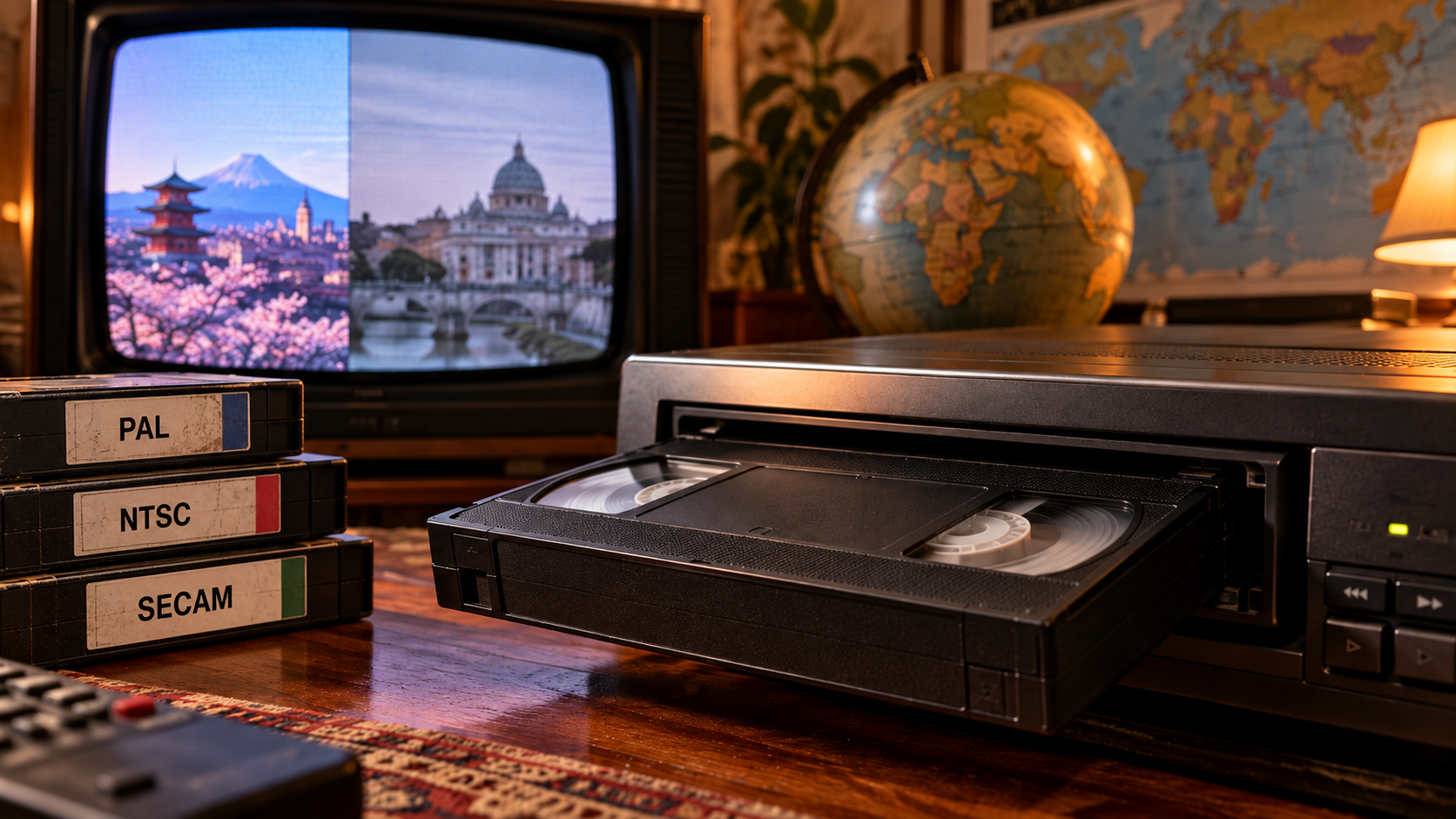
Are VHS tapes region locked? No. A VHS tape carries no region code, no hidden flag and no digital lock telling your VCR to refuse it. But every tape is recorded in a TV standard - PAL, NTSC or SECAM - and a VCR built for one standard often can’t make sense of another. So an American tape slotted into an old British VCR can fail just as badly as a locked DVD, even though nobody deliberately locked it.
Key points
VHS tapes have no region coding. The playback problems people blame on “region locking” are caused by different TV standards: PAL, NTSC and SECAM.
The UK used PAL, North America and Japan used NTSC, and France used SECAM, and a VCR built for one standard often can’t play the others properly.
Many later British VCRs can play American NTSC tapes using a hybrid signal called PAL 60, but very few American VCRs can play PAL tapes.
Digitising a tape removes the problem for good, because a digital file plays on any modern device in any country.
Are VHS tapes region locked? The short answer
Region locking is a deliberate restriction. Someone decides that a product bought in one part of the world shouldn’t work in another, and builds that rule into the disc and the player.
VHS never had anything like that. There’s no “Region 2” logo on a VHS box because there was no such thing as a VHS region.
What people remember as VHS region locking is a technical clash between television systems. Back in the analogue era, countries built their TV networks on different standards, and VCRs were made to match the TVs they were sold alongside. Tapes were recorded to suit those machines. Cross the border with your tape and the machine on the other side may not speak its language.
The result feels like a region lock. The cause is completely different.
What actually stops a foreign VHS tape from playing?
Three main analogue colour TV standards divided up the world: NTSC, PAL and SECAM. They differ in how many lines make up each picture, how many pictures are shown per second, and how colour is squeezed into the signal.
According to the Museum of Broadcast Communications’ Encyclopedia of Television, NTSC uses 525 lines per frame at roughly 30 frames per second (29.97, to be exact), while PAL uses 625 lines at 25 frames per second and runs on a 50Hz frequency rather than NTSC’s 60Hz. SECAM, developed in France, also uses 625 lines at 25 frames per second, but encodes colour in its own way.
Here’s who used what:
PAL: the UK, Ireland, most of Western Europe, Australia, New Zealand, India, China and many others. The same encyclopedia notes PAL was standard in more countries than either of its rivals.
NTSC: the United States, Canada, Mexico, Japan, South Korea and much of Central and South America.
SECAM: France, plus parts of Eastern Europe, the former Soviet Union, the Middle East and francophone Africa.
The Museum of Broadcast Communications puts it bluntly: the three standards differ enough that a tape recorded in PAL won’t play on a VCR set up for NTSC or SECAM, and the same goes in reverse.
So what does failure actually look like? It isn’t always a blank screen. Depending on the mismatch, you might get a picture that rolls up the screen, a picture that’s stable but in black and white, a scrambled mess, or just a blue screen while the sound plays on. One Canadian buyer on the VideoHelp forum described exactly that last scenario after ordering a film from France: black or blue screen, faint audio. The case turned out to say SECAM.
You’d be gutted - you can hear the film you paid for, but you can’t watch it!
Region codes vs TV standards: why the difference matters
DVD region codes were introduced in 1997 as a digital rights management technique, according to Wikipedia’s entry on the subject. Their job was to let rights holders control how a release was distributed internationally, including its content, release date and price in each region.
The main reason was timing. Films used to hit cinemas in different countries months apart, and studios didn’t want someone in London importing an American DVD before the film had even opened in British cinemas. Region coding stopped that.
VHS incompatibility had nothing to do with protecting release windows. It was a side effect of engineering decisions made decades earlier, when countries chose their colour TV systems. SECAM, for example, launched in France on 1 October 1967, per Wikipedia. Those decisions had nothing to do with Hollywood.
In our view, this is the bit worth remembering. DVD region locks were a business choice dressed up as a technical one. VHS incompatibility was a genuine technical accident. One was built to stop you. The other just happened to. That’s probably why VHS collectors tend to feel far less annoyed about it than DVD importers did.
There is a knock-on effect, though. Because the video world was already split into PAL and NTSC territories, DVD regions loosely followed the same lines. American DVDs were NTSC and Region 1, while European DVDs were PAL and Region 2. Some DVDs therefore had two problems at once: the wrong region and the wrong TV standard.
Can a UK VCR play an American NTSC tape?
Often, yes. This is the good news for anyone in Britain with a box of American tapes.
Plenty of later British VCRs included a feature usually labelled “NTSC playback” or “NTSC playback on PAL TV”. The repair FAQ maintained by Samuel Goldwasser notes that most VCRs sold in the UK and Ireland in their later years carried this kind of label, and that switching to NTSC was usually automatic, with the machine taking about a second to adjust.
Here’s the clever bit. The VCR doesn’t fully convert the tape to PAL. As members of the VideoHelp forum explain, it keeps the NTSC timing of 525 lines at 60 fields per second, but shifts the colour signal to the PAL colour frequency of 4.43MHz. The result is a hybrid signal known as PAL 60. Your TV still has to cope with a 60Hz picture, which most later CRT sets and pretty much every modern flat screen can do.
So before you assume an American tape won’t work, check the front panel or the manual of your VCR for words like “NTSC playback”, “NTSC 4.43” or “PAL 60”. If you spot one, you’re probably fine.
Going the other way is much harder. Very few American VCRs were ever built to play PAL tapes, so if you’re sending your British home videos to relatives in the US or Canada, don’t expect their old VCR to cope.
The awkward cases: SECAM, MESECAM and PAL-M
If PAL and NTSC were the main event, SECAM and PAL-M were the complicated sideshows.
SECAM caused problems even within its own family. A text file on world TV standards, circulated widely in the early internet era, explains that there were two ways of recording SECAM onto VHS. Standard (or “French”) SECAM was one. The other was MESECAM, short for Middle East SECAM, which let PAL VCRs record SECAM broadcasts with only minor modifications. Swap tapes between a MESECAM machine and a French SECAM machine, and the picture plays back in black and white.
Brazil went its own way with PAL-M. According to the same source, PAL-M squeezed PAL colour into the same frequency space as NTSC. The upshot was that NTSC and PAL-M tapes could be swapped between machines, but only in black and white.
If you’ve got SECAM tapes, especially French ones, we’ll be honest: they’re the hardest of the lot to play today. SECAM VCRs were never common in Britain, and the machines that handle French SECAM properly are rarer still.
How to tell which standard your tape is
The tape won’t tell you itself, but the evidence around it usually will.
Start with the packaging. Shop-bought films often state the standard on the spine, the back of the case or the label on the cassette. Look for “PAL”, “NTSC”, “SECAM” or abbreviations like “VHS PAL”. The Canadian buyer mentioned earlier eventually found “SECAM” printed on the case once he knew what to look for.
Next, think about where the tape came from. A film bought in a US shop will almost certainly be NTSC. One bought in Paris is likely to be SECAM. Anything bought in the UK will be PAL.
Home recordings are trickier. The standard depends on the camcorder or VCR that recorded the footage, not the blank tape it went on. So if your aunt in Toronto posted you a tape of her wedding in 1992, it’s almost certainly NTSC, even if the blank cassette came from a British shop.
That last scenario is more common than you might think. Families spread across the Atlantic swapped tapes for years, and plenty of those recordings are still sitting in British lofts, unplayable on the VCR they’re stored next to.
Your options for playing a foreign tape today
You’ve got three realistic choices.
The first is a multi-standard VCR. These machines can play PAL, NTSC and sometimes SECAM tapes. They were sold mainly in Europe, Asia and the Middle East and are still available second-hand. The catch is that you’re buying a decades-old machine with rubber belts, worn heads and no warranty. If it’s faulty, it can chew the very tape you’re trying to watch.
The second is a standards converter, a box that converts a video signal from one standard to another. These were mainly professional kit, and they add another step where quality can be lost.
The third is to stop worrying about the VCR altogether and get the tapes digitised. Arapahoe Libraries, a US public library network, recommends digitising as the most future-proof option for tapes in any of the three standards, since it removes the compatibility problem and stops further decay of the tape.
We’d lean firmly towards that third option, and not just because it’s what we do. A second-hand VCR solves the problem for one machine in one room. A digital file solves it everywhere.
Why digitising sidesteps the whole problem
A digital video file has no PAL or NTSC lock. An MP4 made from an American tape plays on a British laptop, a phone in Australia or a smart TV in France without any fuss.
Good transfers keep the tape’s native characteristics. A PAL tape should be captured at its own resolution and frame rate, and an NTSC tape at its own. Converting between standards during transfer can introduce jerky motion or blurring, so the cleanest approach is to leave each tape as it was recorded.
At Digital Converters, we transfer videotapes at standard definition. That’s the resolution the tape actually holds, so stretching it to HD or 4K doesn’t add any real detail. We don’t apply AI enhancement by default either. The technology isn’t consistent enough on standard definition video yet, and it can introduce odd-looking artefacts that were never on the original tape. We’d rather give you an honest copy of what’s there than a guess at what might have been.
If you’ve got tapes recorded abroad, we can help. We convert NTSC and SECAM tapes as well as PAL for most of the formats we handle, so American home videos, French films and recordings sent by relatives overseas can all be turned into files that play anywhere. Get in touch if you’re unsure about anything.
Final thoughts
VHS tapes aren’t region locked, and anyone who tells you otherwise is mixing up two different problems. But that doesn’t mean every tape plays everywhere. PAL, NTSC and SECAM split the world as effectively as any region code ever did, just without anyone planning it that way.
For most people in the UK, the realistic worry is NTSC tapes from North America, and there’s a fair chance a later British VCR can handle those. SECAM tapes are a much tougher nut to crack at home, which is exactly where a conversion service earns its keep.
In my opinion, if a tape matters enough that you’re researching how to play it, it matters enough to get it off the tape for good. VCRs are only getting older, and tapes don’t improve with age.
If your old tapes are sitting in the attic, now’s the time to act, because they won’t look any better next year. Send them to us and we’ll transfer them at their original standard definition, capturing every bit of detail still on the tape, so you can watch them on any screen for years to come. Our VHS to digital service is the easiest place to start.