Get 20% off orders over £50 with discount code REWIND
 01423 319041

What do you want to convert?
Back to Blogs
What Resolution Is VHS? Pixels, Lines & Quality Explained
Sean Parle • 25 September 2026
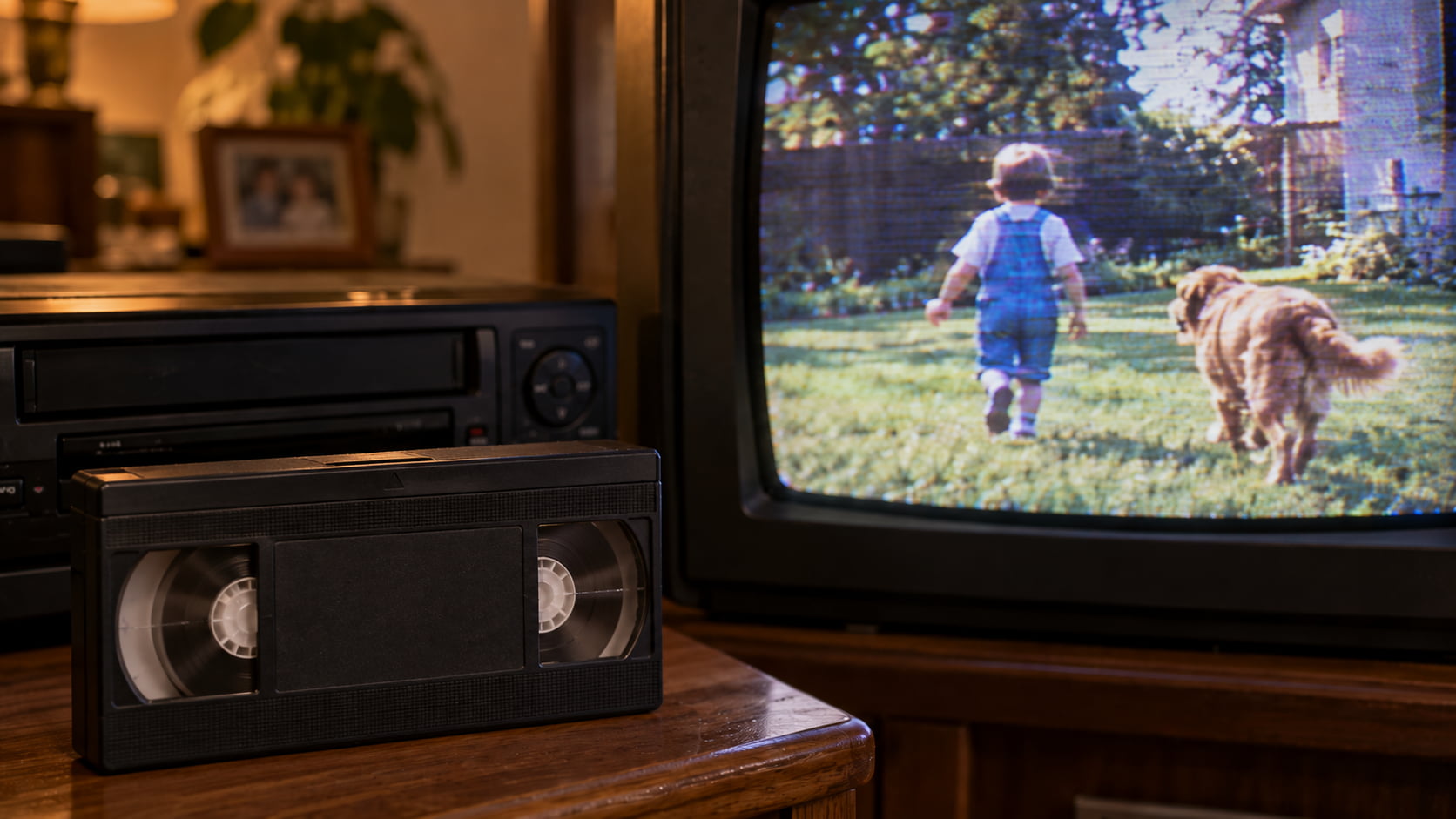
A standard VHS tape resolves around 240 lines of horizontal resolution. In digital terms, that works out to roughly 330 x 576 pixels for a UK (PAL) tape and about 330 x 480 for an American (NTSC) one. A DVD holds 720 x 576, and a 4K TV shows 3840 x 2160. VHS carries a tiny fraction of the detail your current telly can display, which is exactly why your old tapes look so soft today.
Key Points
VHS records around 240 lines of horizontal detail, which translates to roughly 330 x 576 pixels on a UK tape and about 330 x 480 on an American one.
Colour detail on VHS is far lower than brightness detail, at around 30-45 lines, which is why colours smear and bleed on playback.
Recording speed, dubbing, tape age and the type of connection used all reduce picture quality beyond the format's basic limits.
Tapes should be digitised at 720 x 576 (PAL) or 720 x 480 (NTSC), and AI upscaling can make footage more watchable but can't recover detail the tape never recorded.
VHS Resolution in Numbers
You'll see one figure quoted more than any other: 240 lines. The Getty's Art & Architecture Thesaurus, which archives such as the University of Notre Dame's use to catalogue their collections, describes VHS as a half-inch consumer format developed in the 1970s with 240 lines of horizontal resolution.
That 240 refers to brightness detail, known as luminance. It's the black-and-white part of the picture, and it does most of the work in making an image look sharp.
The number isn't random - it actually comes from bandwidth. VHS records roughly 3 MHz of luminance signal, and each MHz of bandwidth equals about 80 lines of resolution. Three times 80 gives you 240. Simple.
JVC didn't just pick a low figure out of laziness, either. A US patent for a double-deck VCR explains that the VHS standard limits luminance to 240 lines to stop the brightness signal interfering with the colour signal on the tape. The format was a compromise from day one, squeezing a whole TV picture onto a slow-moving strip of half-inch tape.
Colour is where VHS really struggles. The format uses a system called "colour under", which shifts the colour signal down to a much lower frequency before recording it. A Sencore technical guide for TV repair engineers lists that frequency as 629 kHz for VHS. Low frequency means low detail. Historical accounts of the format war put VHS colour resolution at around 30 lines, and one member of the digitalFAQ forum measured about 45 lines when testing a JVC deck through S-Video.
Compare 30-45 lines of colour with 240 lines of brightness, and you'll understand why reds bleed into faces and bright jumpers look like they've been coloured in with felt tips.
On paper, 240 lines sounds pitiful. But VHS was never designed to be watched on a 65-inch OLED. On a 21-inch CRT viewed from across the living room, it looked perfectly fine, and millions of people were happy with it for three decades.
Why "Lines of Resolution" Is So Confusing
Most people assume "240 lines" means 240 rows stacked from top to bottom. It doesn't, and this is where much of the confusion around VHS begins.
There are two completely different kinds of "lines" in analogue video. Scan lines are the rows the TV draws from top to bottom. UK television uses 625 of them, with 576 visible on screen. TV lines are a measure of horizontal detail - how many alternating black and white vertical stripes you can make out across the picture before they blur into grey mush. The 240 figure for VHS is this second kind.
Even people who handled video every day got this wrong. I found a poster on the Doom9 forum in 2002, who admitted he'd always assumed VHS specs referred to vertical resolution, until he tested recordings of broadcast test patterns and found that 3 MHz bars reproduced cleanly while 4 MHz bars didn't.
There's another twist. TV lines are counted across a width equal to the picture's height, not the full width of the screen. On a 4:3 TV, the full width is a third wider than the height. So 240 lines per picture height becomes about 320 across the whole screen. That's where the commonly quoted pixel figures come from.
Vertical resolution has its own catch, called the Kell factor. Because of how a picture is scanned line by line, you never get the full detail those lines suggest. Engineering sources typically put the Kell factor between 0.6 and 0.8. Using 0.7, a system with 480 visible lines delivers about 336 lines of real vertical detail.
Honestly, I think manufacturers were happy to let this muddle carry on. A spec sheet shouting "240 lines" meant nothing to the average shopper, and a bigger number on a rival machine looked impressive, whether or not you could actually see the difference.
PAL vs NTSC: Why UK Tapes Are Different to US
VHS wasn't one format worldwide. It came in flavours, depending on the TV system of the country you lived in.
The UK used PAL, which draws 625 lines at 25 frames per second, with 576 of those lines visible. The US and Japan used NTSC, which draws 525 lines at roughly 30 frames per second, with around 480 visible. France and parts of Eastern Europe used SECAM, a third system.
These weren't just labelling differences. The Canadian Conservation Institute points out that the three systems are incompatible, so a tape recorded in one needs converting before it'll play properly on equipment built for another. Even the tape boxes were different. Blank cassettes marked with a "T" (like a T-120) were for NTSC, and cassettes marked with an "E" (like the E-180 you'll find in most British lofts) were for PAL and SECAM.
What does this mean for resolution? Horizontal detail is limited by the tape's bandwidth, so it's broadly similar on both systems at around 240 lines. But PAL has roughly 100 more visible scan lines, so a UK tape carries a bit more vertical detail. The trade-off is motion. NTSC's higher frame rate looks slightly smoother on fast action.
If you've ever inherited tapes from American relatives and found they play in black and white, or not at all, on a UK VCR, this is why.
What Is VHS Resolution in Pixels?
Here's the awkward truth: VHS doesn't have pixels. It's an analogue format, and the picture is a continuous wave of signal, not a grid of dots. Any pixel figure is an approximation.
That said, the approximations are useful. Wikipedia's VHS article, quoted on the NESdev forum, puts NTSC VHS at about 333 x 480 pixels for brightness and just 40 x 480 for colour. Posters on the VideoHelp forum, which is full of people who've spent years capturing tapes, generally land on 320 to 330 pixels across as the agreed figure, once you account for bandwidth, the Kell factor and interlacing.
Apply the same logic to a UK tape and you get about 330 x 576.
You'll also see people online describe VHS as "240p". I'd say that's half right at best. Each NTSC frame is interlaced, meaning it's made of two fields, each holding half the lines. So a single NTSC field has about 240 lines, which is where the "240p" idea probably comes from. But a PAL field has 288 lines, and the "240 lines" in VHS specs refers to horizontal detail anyway. Two different 240s have been mashed together, and the result is a figure that doesn't really describe anything properly.
How VHS Compared with Its Rivals
VHS was never the sharpest format available. It won on price and recording time, not picture quality.
Betamax, Sony's rival format, launched in Japan in May 1975. Its original Beta I speed offered 250 lines of horizontal resolution against VHS's 240 - a tiny margin. Early Beta tapes could only record for an hour, though, so Sony introduced Beta II to double recording time. That slower speed cut Betamax's resolution to around 240 lines, wiping out its advantage. Accounts of the format war say that, in the end, users of both formats could expect almost identical brightness resolution of 230 to 250 lines. Sony effectively admitted defeat in 1988 when it announced it would start making VHS machines.
In my opinion, the "Betamax was better" legend is mostly marketing. The gap existed, but it was small, and it disappeared as soon as Sony chased longer recording times.
Broadcast TV itself carried more detail than VHS could record. Analogue NTSC cable broadcasts were limited to about 330 lines, so every programme you taped lost a chunk of sharpness before you even pressed play.
JVC tried to close that gap with S-VHS, launched in Japan in April 1987 alongside the HR-S7000 VCR. By raising the luminance carrier from 3.4 MHz to 5.4 MHz, S-VHS pushed resolution to around 400 to 420 lines. LaserDisc sat at a similar 420 lines, and Sony's ED-Beta reached 500. Professional digital video came in at about 520. Here's the catch: S-VHS did nothing to improve VHS's weak colour signal, which is one reason a trained eye could still tell an S-VHS recording from live TV.
Put in rough pixel terms, the comparison looks like this for UK formats:
Format | Approximate resolution | Approximate pixel count |
VHS (PAL) | 330 x 576 | 190,000 |
DVD (PAL) | 720 x 576 | 415,000 |
Full HD | 1920 x 1080 | 2,070,000 |
4K | 3840 x 2160 | 8,290,000 |
By this rough measure, a Full HD picture holds around 11 times the detail of a VHS tape, and 4K holds about 44 times as much. Treat those figures as ballpark, since VHS isn't made of pixels in the first place.
Why Your Old Tapes Look Worse Than You Remember
Plenty of people dig out a family tape, pop it in an old VCR connected to a modern TV, and wonder if their memory was playing tricks. Usually it's a combination of factors, and 240 lines is only the start.
Recording speed makes a big difference. According to the Canadian Conservation Institute, LP mode runs the tape at half the speed of SP, and EP runs at a third. Slower tape means less tape per second of video, which means a softer, noisier picture. Most shop-bought films were recorded in SP. Home recordings are a lottery. In the UK, SP was by far the most common setting, and PAL VCRs stuck with SP-only for longer than American ones did. PAL EP mode existed on a small number of machines, but the digitalFAQ forum's resident experts describe its picture quality as atrocious.
Copies make things worse. Every time a tape was dubbed from one VCR to another, the new copy lost detail and gained noise. That "copy of a copy" of a wedding video your uncle made in 1994 might be three generations removed from the original.
Tapes also age badly. Magnetic tape can stretch, shed its coating, and grow mould if it's been stored somewhere damp. Each of these chips away at picture quality.
How you watched it mattered too. Plugging a VCR into a TV through the aerial socket (RF) combines sound and picture into one signal and throws away detail. Period sources noted that even S-VHS's higher resolution only showed up when you used separate audio and video connections. In the UK, a SCART lead was the better option, and many people never used one.
Then there's your TV. A small CRT softened everything and hid a lot of flaws. A big flat screen does the opposite. It stretches that 330-pixel-wide picture across a huge panel, and every smear, wobble and speck of noise gets magnified. Nostalgia isn't lying to you - your tapes genuinely looked better on the equipment they were made for.
What Resolution Should You Digitise VHS At?
The honest answer is the resolution the tape was recorded in: standard definition. For UK tapes, that means a 720 x 576 frame. For US tapes, it's 720 x 480.
That's how we handle every tape at Digital Converters. When you send us VHS for our VHS to digital service, we convert it at SD, and we don't upscale it to HD or 4K. We're not cutting corners - there's simply nothing to gain from it.
Upscaling can't add detail that was never recorded. A VHS tape holds about 240 lines of brightness detail. Stretch it to 1920 x 1080 and you still have those same 240 lines, just spread across more pixels. The file gets bigger, it takes longer to upload and share, and the picture looks no sharper. Your TV, laptop or phone already scales SD video up to fill the screen when it plays it, so upscaling during conversion just locks you into a larger file for no benefit.
You might wonder why SD capture uses 720 pixels across when VHS only resolves about 330. It comes down to how analogue signals are sampled. One VideoHelp forum contributor worked through the maths and found that VHS's roughly 3 MHz bandwidth needs about 457 pixels across to capture reliably. So a full SD frame catches everything on the tape, while a "half resolution" capture at 352 pixels throws detail away for good. The original 4:3 shape matters too, because stretching VHS to fill a widescreen TV makes everyone look short and wide.
We'd rather give you a faithful copy of what's on your tape than a bigger file pretending to be something it isn't. A clean SD master is also the best starting point if better restoration tools come along in future.
If you're converting tapes to digital files at home with your own VCR, the same rule applies. Capture at native SD and keep that file as your master copy.
Can Upscaling or AI Make VHS Look HD?
No, not at the time of writing, in September 2026, and that's why we don't currently offer AI upscaling.
Traditional upscaling just stretches the picture. AI upscaling goes further. It guesses what the missing detail should look like, based on patterns learned from huge numbers of other images. When it guesses wrong, you don't get a blur. You get something invented. These made-up errors are often called hallucinations, and on home videos they tend to appear on the things you care about most: faces, hands and writing.
Netflix gave everyone a very public example in early 2025. It added the 80s sitcom A Different World to its catalogue and used AI to lift the show's low resolution. As Creative Bloq reported, viewers expecting a crisp HD picture got warped text and melted faces instead. The problems started as early as the opening credits, with odd-looking facial features, wonky hands and mangled logos. Throughout the episodes, viewers spotted cast members' faces warping, strange glitches, and text that had turned into gibberish.
Creative Bloq's Natalie Fear concluded that the technology isn't refined enough to do the job without distorting what's on screen. She also felt the fake glossy finish stripped away the show's 80s charm and said she'd take authenticity over perfection. We couldn't agree more.
Think about what that means for a family tape. This was one of the biggest streaming services in the world, working with professionally shot TV footage, and the result still made headlines for all the wrong reasons. Now imagine the same thing happening to your dad's face in a 1991 holiday video. A glitch on a sitcom is embarrassing for Netflix. A glitch on the only footage you have of someone you've lost quietly rewrites a memory. We're not willing to take that risk with our customers' tapes.
That's our position for now, not forever. AI tools are improving quickly, and we're keeping an eye on them. When they can enhance footage without making things up, we'll happily take another look. Until then, the most accurate copy of your VHS tape is an SD one.
Is VHS Quality Worth Preserving?
Nobody keeps a box of VHS tapes for the resolution. They keep them for first steps, school plays, weddings, and the one Christmas where Dad accidentally filmed the ceiling for 20 minutes.
That's why the format's technical limits matter less than people think. A blurry 330 x 576 recording of someone who's no longer here is worth infinitely more than a pin-sharp 4K video of nothing in particular.
The real concern is time. Magnetic tape degrades, VCRs are no longer made, and the ones still working are getting harder to repair. The picture on your tapes today is almost certainly the best it'll ever be from here on.
Personally, I've grown fond of the VHS look. The soft edges, the smeared colours, and the wobble at the bottom of the frame have become shorthand for a whole era, which is why music videos and films now fake it on purpose. VHS was never sharp. But it was ours, and 240 lines turned out to be more than enough to capture what mattered.
If you've got old tapes in the attic, don't wait for them to fade any further. Send them to us, and we'll convert them at the quality they were recorded in, so your memories look exactly as they did the first time you pressed play. Our VHS to digital service is the easiest place to start.